Sometimes I forget I have a website. Sometimes I forget for a long time. Sometimes I remember.
A couple of stories were published waaaay back near the start of the year:
“From Here” in Kaleidotrope is the end of a story. Figured it was best to start there, since we all know the start. It’s fairly short, and if anyone ever does a film adaptation, it’ll have to be a single take. Charles Payseur in Locus called it “an interesting statement on heroes, exhaustion, and care”. One day, when we can all go to cons and hang out in the bar together, I’ll tell you the secret origin story of this one.
“Three Past Desolation Cut” is not short. It’s available as an ebook from all the usual places, or you can read the whole thing at Lost Colony Magazine.
Armed with only three bullets, an old map, and a score to settle, Bonnie Murtaugh may be in the Splintered Man’s territory, but she won’t let anything come between her and vengeance.
I’ve always loved westerns and this isn’t the first time I’ve tried to write one of those Big Sky stories (that would be “Wyoming”, available in Everything Is Fine) . It won’t be the last.
That’s all I got for now. I’ll try not to be a stranger to my own site for so long again. But if I am, know it’s because I’m out walking under the Big Sky.
Back at the start of the year I realised something. My writing tools weren’t working for me.
I’ve used Scrivener for years. I’ve written a couple of novels and any number of short stories with it. But there was something about it that just didn’t quite suit me, and it took a while to figure out what it was.
I’m a software developer. I’ve been cranking out code since Apple II days. I grew up with green text on a black background. I don’t get to code as much these days. Mostly I draw boxes and arrows on whiteboards, communicating the plan to the people who are really going to do the work. But every now and then I still get the chance to crank out some code. When I do, I’m using tools I’ve known for years: Visual Studio,VS Code, Notepad++ and the command line. I know these tools back to front. Yeah, I’m one of those guys who still does all their Git work at the command line instead of using GUI tools. So I started wondering if I could use those same tools for fiction.
Visual Studio is an absolute monster of a product and it’s still the best Integrated Development Environment you’ll find. Visual Studio Code is Visual Studio’s little brother. It’s far smaller, takes less space to install, runs faster and works on Windows, Linux and OS X. And it’s free. If all you want is a solid text editor, VS Code will do the job. But it’s also got a very rich collection of plugins and extensions. Did I mention it’s free? Because it’s free.
So in January I started working on fresh stories using VS Code instead of Scrivener. And something just clicked.
I still don’t know exactly what it was. Perhaps because this was a tool I used every day at work, there was no ceremony to it. Perhaps it had got to the point where watching the Scrivener loading screen was telling my brain ‘Behold! The Genius is Preparing to Write!’, which immediately caused by imposter syndrome to kick in and my imagination to curl up in the corner. But when VS Code started the message was ‘eh, time to go to work’. Whatever the reasons, as soon as I switched to Code, words started flowing faster than they had before.
But great as VS Code was for kickstarting my writing, there were a few pieces missing. If I split a story into a separate file for each scene it was hard to get a total word count. I wanted to add target word counts for scenes and chapters too, and perhaps a way to compile all these pieces into a completed manuscript. I couldn’t find a plugin that did everything I needed in the way I wanted.
So I built something.
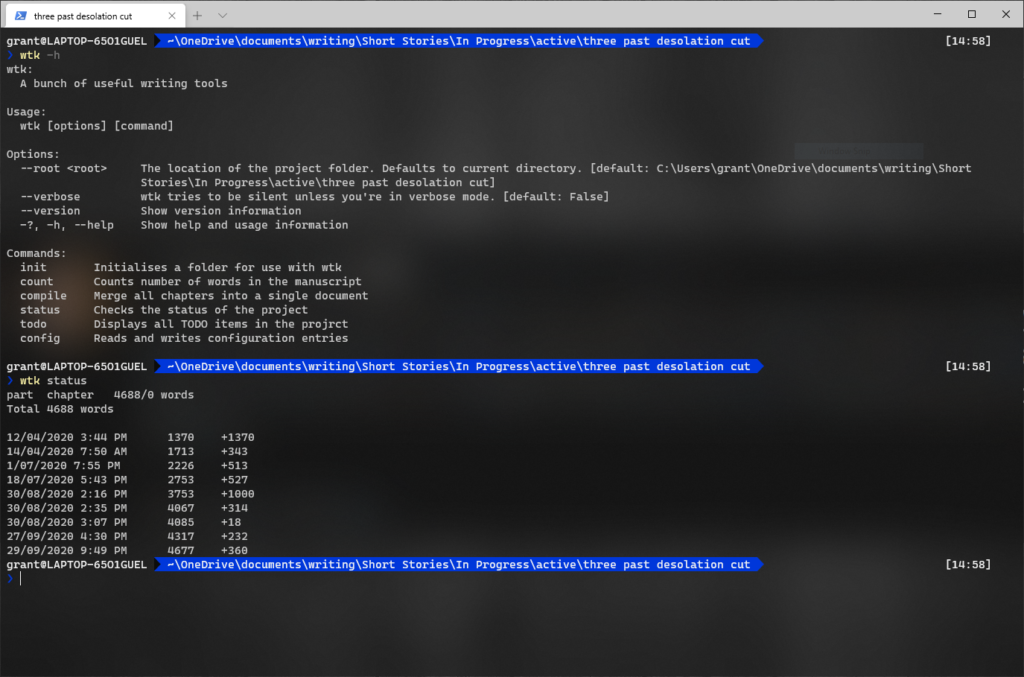
wtk is ‘Writer’s Toolkit’. It’s a minimal collection of tools designed to help writers who like to work with words the same way they work with source code. Wtk is opinionated, and designed to match the way I work. It’s open source and available here.
Writing fiction using programmer’s tools is definitely not for everyone. And even if you’re the kind of person who’s happier with vi than Word, wtk might not be your cup of tea. But if you want to use it, go for it. Hopefully it can help other people as much as it has helped me.
Year’s Best Aotearoa New Zealand Science Fiction & Fantasy Volume 1 is now available. “A Brighter Future” is reprinted there, along with many other brilliant stories. New Zealand speculative fiction is extremely healthy at the moment and I’m very pleased that Paper Road Press has committed to an annual anthology.
Trickster’s Treats #3: The Seven Deadly Sins Edition is out now from Things In The Well. It’s a very large collection of small things: forty-nine pieces of flash fiction based on the seven deadly sins. My story “Eternity Compound” is in the pride section.
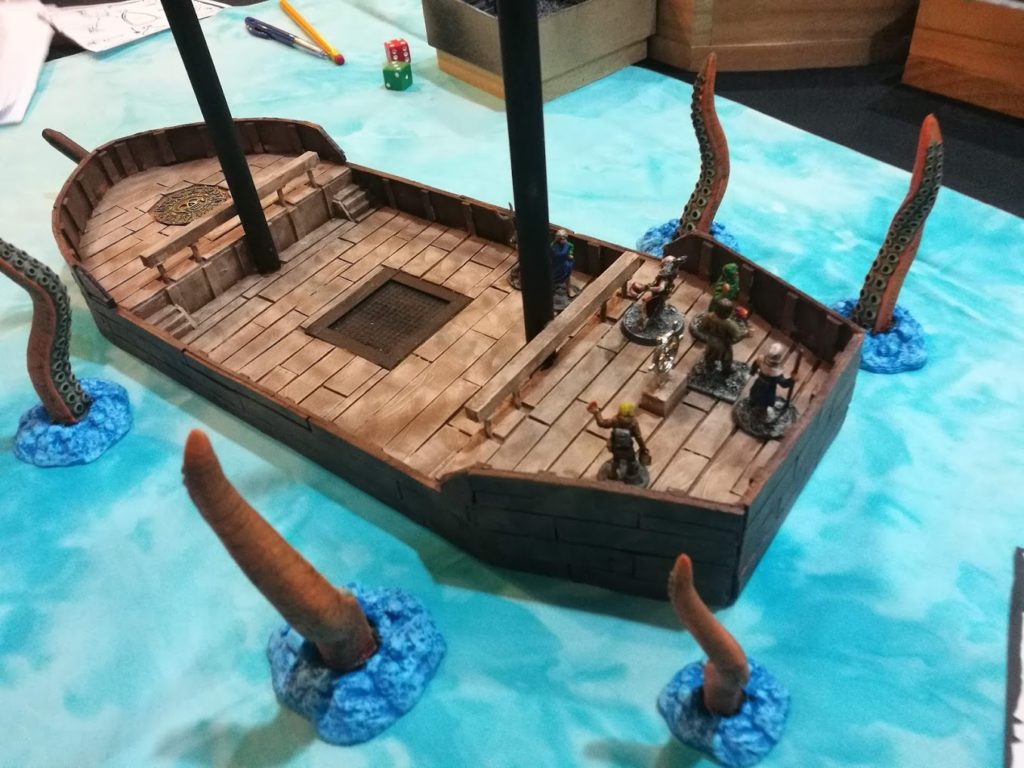
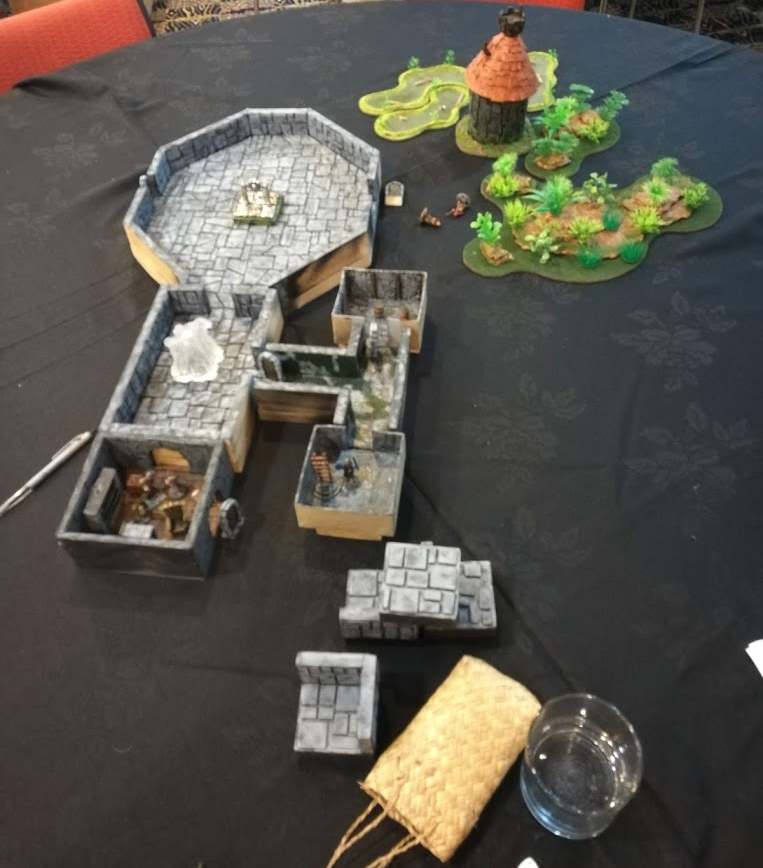
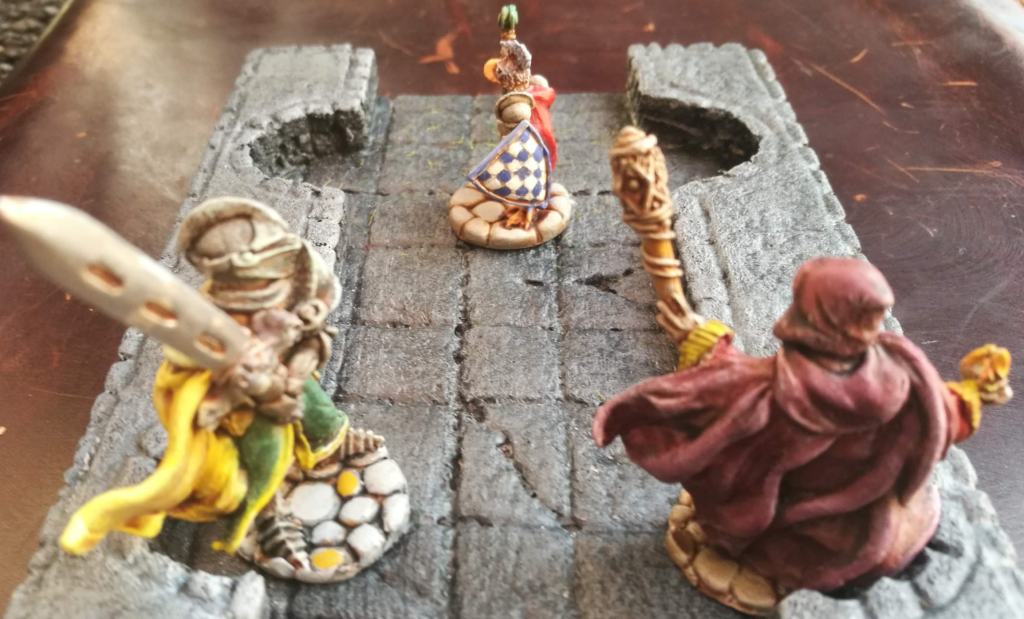
I spent last weekend at Geysercon helping to run a particularly epic game. Three DMs, running three different tables simultaneously in the same module was a massive challenge but a hell of a lot of fun.
There have been a few requests for a copy of the rules, so here you go. It’s a very simple system – only a couple of pages of rules, designed to be fast and flexible in a noisy setting with people who may have never played before.
Thanks to everyone who came to play (and frequently died in interesting ways).
Something I should have mentioned a month ago (or perhaps I did and the post was lost in the time streams for a while):
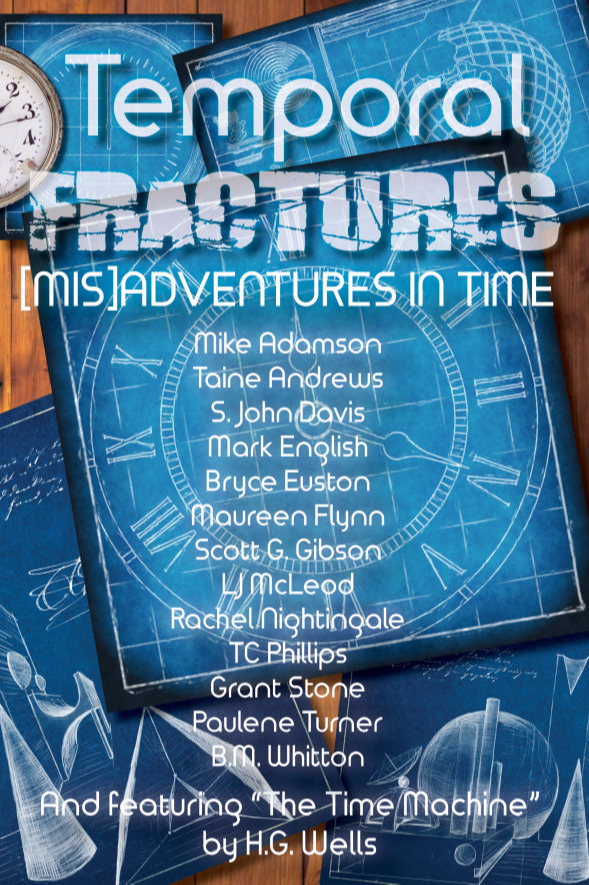
Temporal Fractures: (mis)adventures in time is a new anthology from Specul8 Publishing. 13 time-travelling tales. All authors are from Australia and New Zealand except for one. You may have heard of him – a bloke called H.G. Wells.
My story ‘Starting Over’ is included, about two failed rock stars who travel back in time to try and prevent the assassination of John Lennon.
You can pick up a copy of Temporal Fractures at the Specul8 store
Do we have time for a song? I think we have time for a song.
My imagination seems to like hanging out at the dark end of the street, probably wearing a leather jacket and smoking in an attempt to look cool. But I’ve never written anything specifically Lovecraftian, at least not on purpose.
Until now.
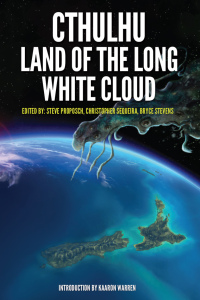
I’m thrilled that my story ‘A Brighter Future’ is part of the latest collection of Antipodean horror from IFWG, Cthulhu Land of the Long White Cloud. This is a fantastic collection featuring a whole bunch of scary kiwis.
If you live in Auckland, you’ll already know that Armageddon is coming – 19-22 October to be precise. There’s a Cthulhu Land of the Long White Cloud panel at 3PM on Sunday. I’ll be there, along with some other fine folk. Come and say hi.
In this collection we find an Aotearoa with the proud history, myths, and legends of the Māori, and the impacts of the white settler’s later presence, and the blended society that encompasses both, but we see the shadow of other things.
Herein lies the cosmic horror of the Old Ones of the Cthulhu Mythos in an anthology featuring Lovecraftian tales from some of New Zealand’s finest speculative fiction writers.
Stay brave. Because here there be monsters.
Tales of terror by: Debbie & Matt Cowens
J. C. Hart
David Kuraria
Tracie McBride
Paul Mannering
Lee Murray
Jane Percival
Dan Rabarts
Grant Stone
Lucy Sussex
Marty Young
Introduction by Kaaron Warren.
Cover art and design by Steve Santiago, and skilfully edited by Steve Proposch, Christopher Sequeira, and Bryce Stevens.
Do we have time for a song? I think we have time for a song.
Always Falling Up, my story of soldiers-as-a-service and insecure data centers first appeared in Use Only As Directed. But now it’s available to read right here. Hope you like it!
Jennell Jaquays has been working on table-top RPGs and video games since the beginning. From Dungeons & Dragons, Traveller and RuneQuest to tiny indie games like Quake and Age of Empires, you’ve probably spent a lot of time in one or more of her worlds.
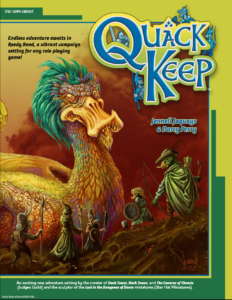
Jennell recently teamed up with Darcy Perry for Quack Keep, a setting for any game system that needs an injection of adventure, comedy and ducks. So many ducks.
I had the opportunity to chat with Jennell about Quack Keep, along with other projects past and future.
What’s with all the ducks?
Jennell: The Ducks. Yes. The ducks. Forty years ago, this new set of role play game rules came out from Chaosium, called Runequest. I picked up my copy at the Origins game convention in Ann Arbor, MI. The convention was a “floating convention” back then, meaning that it moved around the USA from host city to host city. That year, it was in Ann Arbor, a city near where I lived at the time.
Runequest was different. It had neither character classes, nor character levels (as games like Dungeons & Dragons and Tunnels & Trolls did). It was set in a Bronze Age world, rather than in a Medieval One. It also had anthropomorphized ducks as possible player characters. My roommate and I adopted Runequest as our game of choice (though our game group also played Advanced Dungeons & Dragons as well).
Not long after that, I joined Judges Guild as a designer, editor, and illustrator of game adventures for AD&D (first edition) and D&D as well. I was playing D&D and Runequest, but only writing D&D.
My first commercial adventure f
or Judges Guild was Dark Tower. A war between Law and Chaos with an Egyptian theme, set in a pair of buried towers. That adventure came out in 1979. Later that year (I only worked for Judges Guild for a single year), Judges Guild obtained the license to publish adventures based on Runequest as well. I wrote (and illustrated) two adventures for it. One was not about ducks. But the other… well I thought it would be fun to do a pastiche on the cover of Dark Tower. I replaced all the characters (including the statue of Set… though it’s really Anubis, not Set) with duck versions. The adventure itself was serious, but the cover was not. And I didn’t even finish it. I left Judges Guild under my own power (that is, I resigned) at the end of my first year there.
But because of that adventure (an
d perhaps a cover that I did for Chaosium’s house publication, Wyrm’s Footnotes), I became known as the designer/artist who did ducks. Most of my work has NOT been about ducks. But the association has been firmly affixed in gamers’ minds ever since.
I backed Darcy’s third Kickstarter. I liked some of the figures he had sculpted in
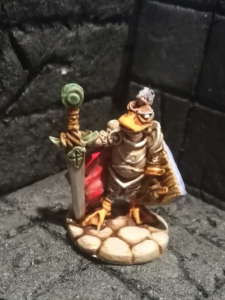
The Duck Knight
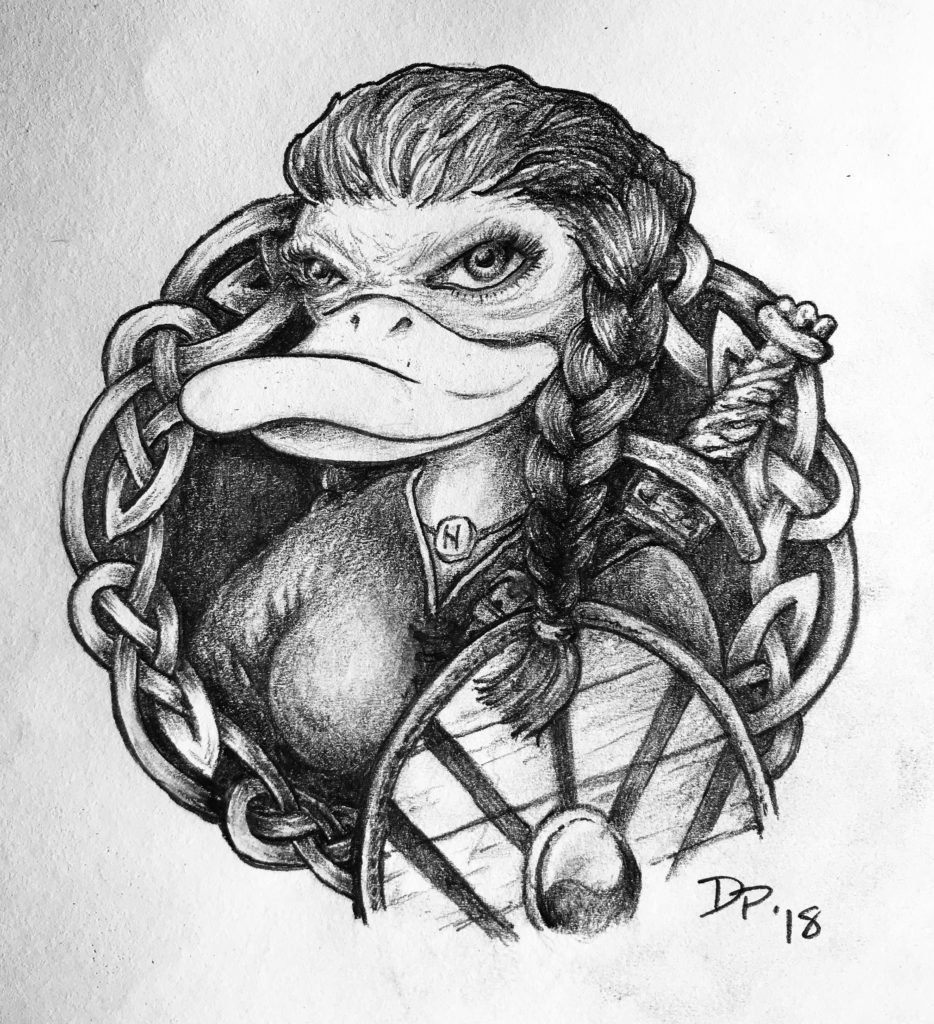
it. And then he showed his Duck Knight figure, and I knew I had to have that one two. And I shared the kickstarter with friends and fans (who I also knew liked ducks). And THAT led to Darcy creating a tribute ch
aracter for me in Kickstarter, Jenn Jaquack the Shield Maiden. By the end, he had included four ducks in the project… and apparently enjoyed sculpting them so much that he wanted to do more.
We began chatting about it, and he suggested a collaboration. He would sculpt ducks, and I would write an adventure around them. He had several figures in mind that he already wanted to create, and I suggested some that I thought would be fun. We drew heavily from our own fannish appreciation of both classic fantasy literature (Eldritch, Coduck the Barbarian, the Grey Moulter, Froduck) and popular entertainment (The Ducktor, Katnip Everquack, the Quack Knight, Wanda Duck). A few were completely original (Mother Henna, Dabbler Green, and Goodie Green). We ran out of space and time in the Kickstarter before we ran out of ideas.
Were there any challenges working with a collaborator on the other side of the world?
Jennell: Probably the biggest challenge was learning each other’s’ wake/sleep/available schedules for when we needed real time interaction with each other. Once that was handled, the rest was all a matter of course.
Reading Quack Keep, the characters and potential stories seem to leap off the page. Was there anything about this project that created such a feeling of vibrancy?
Jennell: I can think of several things that may have contributed to that. One is writing for what in many ways amounts to cartoon characters. That side step from the familiar can be quite freeing. It allowed me to be a bit broader in characterization than I might normally write. Another was that so many of the characters have their roots in pastiches (or even parodies) of characters from popular fiction, media, and culture. We began with ideas for takes on popular characters from fantasy fiction, then moved on into television, motion pictures, and even reality TV shows.
Another was, and this is a slight poke at my collaborator, Darcy didn’t really think about the personalities or backstories of the characters that he was sculpting. He made them interesting visually, but without any thought towards them sharing the same world together, let alone the same neighborhood.
We allowed characters to change and develop as the book content grew. You can probably tell how much I became invested in a character by the depth of their backstory.
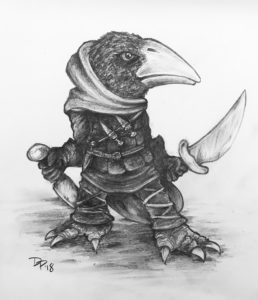
Duke Crow
Occasionally, some characters pretty much added themselves to fill needs in the world. Howie the Human was one of those. He’s one of two human(-ish) characters in the setting that’s mostly birds. Hopefully, both the initial parody and the one that it developed into (a play on another person named Howard) comes through and is fun to play with. Putting the characters together sparked stories based on their potential interactions.
Even now, as I’m getting back into my hobby painting (and miniature customization) I’m creating new characters that could be in the setting. One of the Reaper Bones figures in my collection of “to be painted” figures has a bit of a Puritanical look to his costume and demeanor. I had a duplicate, so I’m converting one into yet another member of the Fowl Folk, Suleiman Krane, a tall, gaunt, dour fowl saved from damnation by his faith, but condemned to search out evil in the world and destroy it.
2017 was a biggest sales year for Dungeons & Dragons at least since the acquisition by Wizards and possibly ever. Do you think this new mainstream acceptance of D&D has extended to other RPGs as well? What do you think the future holds for RPGs?
Jennell: If I’ve learned one thing after 40 years in this business is that it is cyclical. We’re in an upswing right now, revitalized by a set of rules that are modern, but capture the feel of the original. At the same time, people who were kids and young adults in the 70s and 80s are rediscovering their former pastime and creating a market for Old School Revival products. And of course, some of the most successful Kickstarter campaigns in recent years are for high quality board games, often with a D&D or RPG feel to them (and often with amazing game miniatures as well).
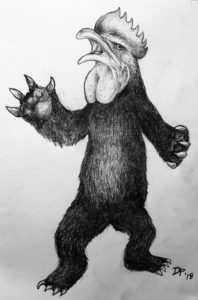
The dread Fowlbear: coming soon to a Kickstarter near you!
I think the future continues to bode well for RPGs. We’ve already seen the rise, and then subsidence of online RPGs which simulated some of what could be done on tabletop but failed to provide the variety of experiences possible with tabletop gaming. With the addition of well-produced, high profile social media ‘casts on Twitch and YouTube, we’re seeing new audiences being brought into gaming virally. I expect an eventual downswing, but hopefully not at the level of crashes that followed the d20 explosion years back.
Now that Quack Keep is put to bed, what’s next?
Jennell: I have an illustration project that I’m a bit behind on, several decks of cards that are compatible with that popular fill-in-the-blank social card game that I produced for a speakers group that I’m a part of that we use as teaching aids about transgender issues, particularly where they intersect with games. And then I decide whether I dive into continuing development on both the game world which I set my D20 game adventures in and the next game adventure (one of several that I have in development) or jump into development for a relaunch of my Central Casting character history books, or just do what I normally do, which is work on all of them at the same time.
Quack Keep is available at Drive Thru RPG
Miniatures, including plenty of ducks, are available at Star Hat Miniatures. The next Star Hat Kickstarter will be kicking off in a few days.
The mythographer Fulgentius allegorizes Cerberus’ three heads as representing the three origins of human strife: “nature, cause, and accident”. I’ve got no idea which one of us is which, but I can tell you that the Floridian head has a new story. Check out Matthew Sanborn Smith’s story Stars so Sharp They Break the Skin at Apex Magazine.
If you’re the kind of person who likes to know how the sausage is made, Andrea Johnson interviews the unsinkable Mr. Smith here. It’s a good one folks.